

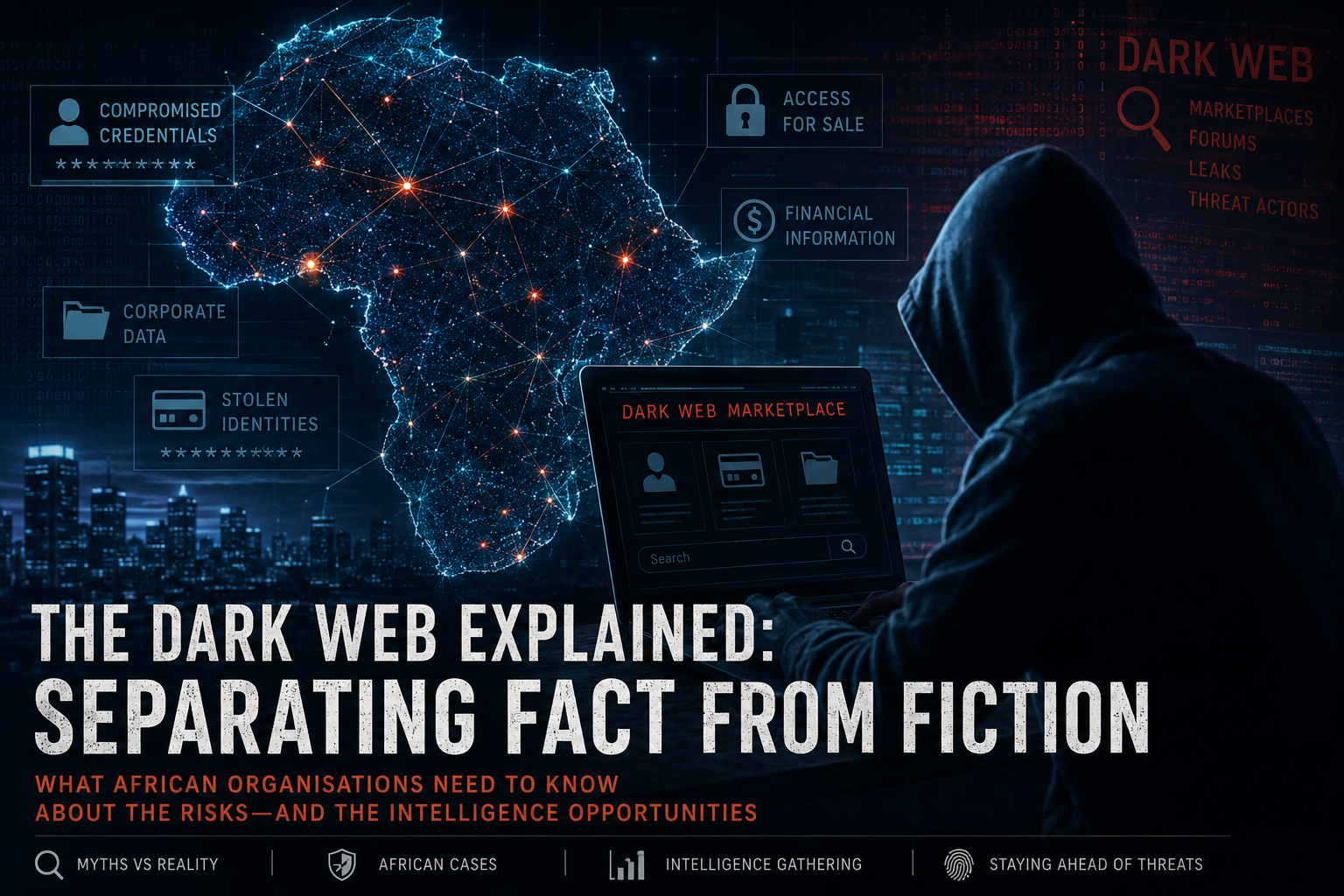
Mentioning the dark web and the
images are almost predictable: anonymous hackers, hidden marketplaces, stolen
identities and an invisible corner of the internet beyond the reach of law
enforcement.
There is some truth behind those
images. There is also considerable fiction.
The dark web is neither a single
criminal marketplace nor an impenetrable digital underworld. It is a concealed
part of the internet where legitimate anonymity and privacy coexist with
criminal activity — and where compromised credentials, personal information and
corporate data may circulate.
For African organisations, that
risk is increasingly relevant. INTERPOL's African Cyberthreat Assessment
Report 2026 describes cybercrime on the continent as an increasingly
industrialised and borderless ecosystem
Understanding the dark web is therefore less about its mystery and more about a practical question: where does stolen information go, how can criminals exploit it, and what intelligence can organisations gain from it?
The Dark Web Is Not What You Think
The surface web is the
publicly accessible internet indexed by conventional search engines. The deep
web includes information that is not publicly indexed, such as email
inboxes, private databases, corporate systems and online banking.
The dark web is different.
It is a deliberately hidden part of the internet, generally accessed using
specialised technologies designed to provide greater anonymity. While that
anonymity can serve legitimate purposes — including protecting journalists and
whistleblowers — it can also provide an environment for criminal marketplaces,
stolen information and illicit services.
The real concern is not simply that
a hidden internet exists. It is what can happen to information once it
leaves the environment in which its owner thought it was protected
Africa's Data Has Become a Criminal Commodity
Personal information, credentials,
financial records and corporate data all have potential value to criminals.
Once stolen, information can be copied, traded, published or reused in further
attacks.
South Africa has already seen the
consequences. In April 2025, Cell C confirmed that information compromised
during an earlier cybersecurity incident had been unlawfully disclosed by
RansomHouse, the threat actor claiming responsibility for the attack
The incident highlights an
important reality:
The breach may be the beginning
of the story rather than the end.
Even after systems are restored,
stolen information can continue to circulate and potentially facilitate fraud,
impersonation, phishing or further attacks.
The wider African threat
environment makes this increasingly significant. INTERPOL reported in August
2026 that cybercrime-related losses across the continent had more than doubled
since 2024, from USD192 million to USD484 million, driven in part by
credential harvesting and increasingly automated social-engineering campaigns
The question after a breach
therefore cannot only be “What was taken?”
Organisations must also ask:
“Where did the information go —
and what could happen to it next?”
Not Everything Posted on the Dark Web Is True
Dark-web forums and leak sites may
contain genuine stolen data, but they can also contain old information,
recycled datasets and exaggerated or false breach claims.
In July 2026, a threat actor posted
“MTN BREACHED” on a hacker forum, claiming to possess customer and
employee credentials.
Closer examination told a different
story. Researchers reviewing samples found discrepancies between the claims and
what the information appeared to represent, while MTN's assessment did not
indicate that the material demonstrated a new compromise of its systems
The case illustrates an important
distinction:
A dark-web claim is an
intelligence lead — not automatically evidence of a breach.
Information must still be assessed
for authenticity, relevance and context. Is it current or historical? Does it
genuinely belong to the organisation? Is it evidence of a new incident, or
recycled information from an earlier exposure?
Dark-web monitoring can tell an
organisation what has been posted.
Intelligence analysis asks:
What can we verify — and what does it actually mean?
From Dark Web to Intelligence
For organisations and
investigators, the dark web can be more than a criminal marketplace — it can
also be a source of intelligence.
Monitoring underground
marketplaces, forums and leak sites may reveal compromised credentials, leaked
corporate information, stolen customer data, references to an organisation by
threat actors or claims that access to its systems is being offered for sale.
But discovery is only the starting
point.
This distinction is particularly
relevant in Africa, where cyberthreat-intelligence capability remains uneven.
INTERPOL's 2025 African assessment found that only 19% of surveyed countries
had a cyberthreat-intelligence database, despite the growing sophistication
of cybercrime across the continent
Finding information is therefore
not enough. It must be assessed, verified and placed in context before an
appropriate response can be determined.
The difference is simple:
An alert tells an organisation
that something has been detected. Intelligence helps it understand what that
detection means.
International Case Study: Operation RapTor
Dark-web anonymity does not
necessarily mean being untraceable.
In 2025, Operation RapTor
resulted in 270 arrests across ten countries, targeting vendors, buyers
and administrators operating on darknet marketplaces. The operation drew on
intelligence generated through earlier investigations and marketplace takedowns
The case demonstrates that
information appearing fragmented or anonymous can become meaningful when
connected with other evidence and analysed in context — reinforcing the value
of intelligence-led investigation.
D-finitive Insights: Monitoring Is Not the Same
as Investigating
Dark-web monitoring can provide
valuable visibility beyond an organisation's own network. But monitoring is
not intelligence — and intelligence is not an investigation.
The distinction lies in verification,
context and analysis.
A set of credentials may be current
or years old. A dataset may originate from the organisation itself, a supplier
or an unrelated source. A threat actor's claim may indicate a genuine
compromise — or simply be an attempt to attract attention.
The value therefore lies not merely
in detecting information, but in determining what it is, whether it is
credible, what risk it presents and what action should follow.
Organisations should neither react
dramatically to every underground claim nor dismiss information simply because
it cannot immediately be proven.
The objective is to turn
information into actionable intelligence — and actionable intelligence into
informed decisions.
Conclusion: Beyond the Myth
For African organisations, the dark
web matters not because of its mythology, but because of what it may reveal —
compromised credentials, stolen information and emerging threats.
The challenge is to distinguish
credible intelligence from noise and turn what is discovered into informed
action.
The question is no longer
whether the dark web exists. The question is: if your organisation's data,
credentials or confidential information appeared there today, how quickly would
you know?
Delivering Clarity. Protecting
Integrity. Driving Accountability.