

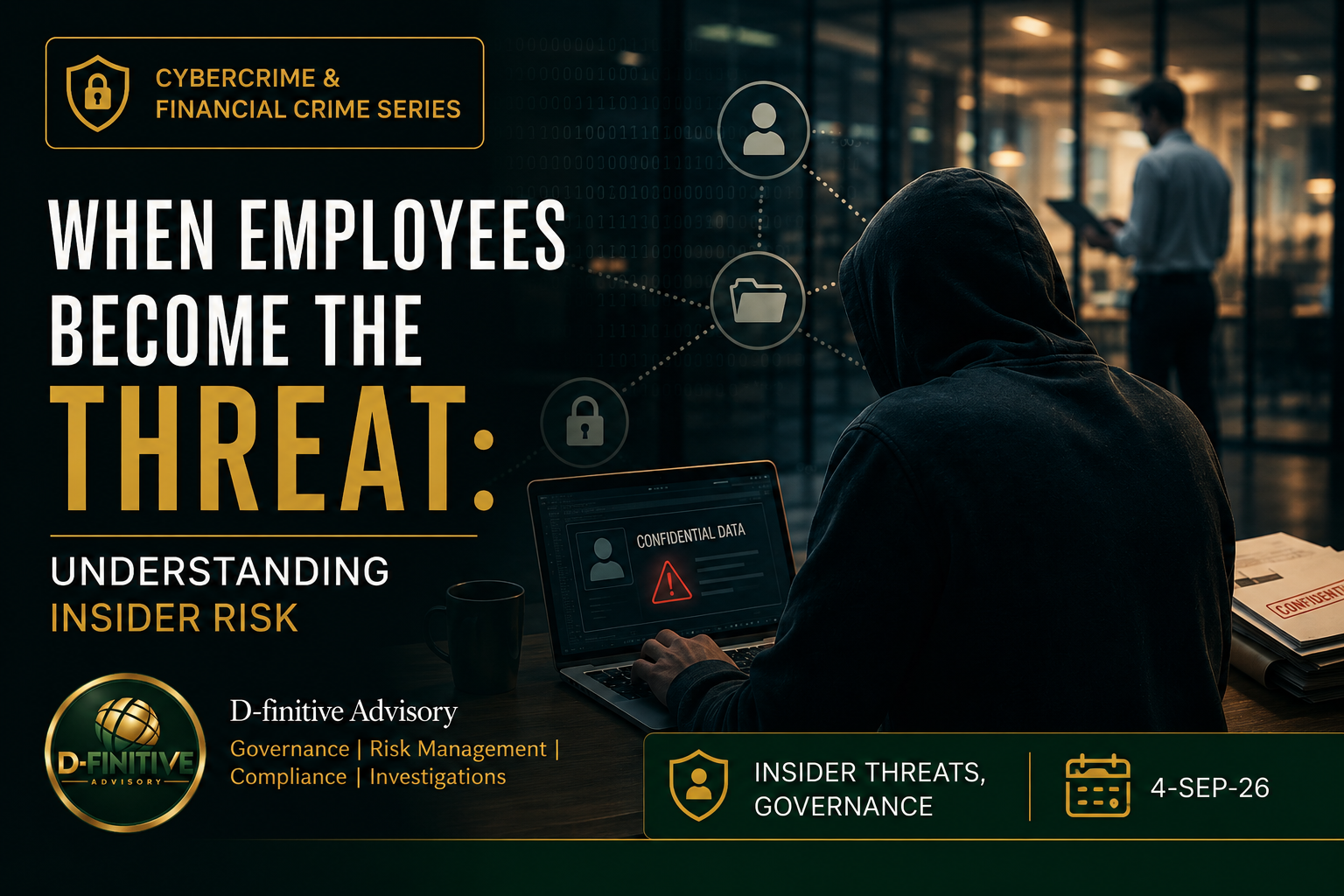
When Employees
Become the Threat: Understanding Insider Risk
The greatest threat to an organisation does not always come from an anonymous cybercriminal operating beyond its walls. Sometimes, the person who already has a password understands the controls and knows exactly where sensitive information is stored presents the greater risk. Employees, contractors and other trusted insiders occupy a unique position: their legitimate access can become the very mechanism through which fraud, data theft, sabotage or serious security failures occur. This is what makes insider risk particularly difficult to manage — the threat may already be inside the organisation, operating behind credentials and permissions that appear entirely legitimate.
What is an Insider Threat?
An insider threat arises when a person with legitimate access to an organisation’s systems, information, premises or resources uses — or inadvertently exposes — that access in a way that causes harm. The insider may be a current or former employee, contractor, consultant, service provider or other trusted party.
Importantly, insider threats are
not always deliberate. A malicious insider may steal information, manipulate
transactions or deliberately compromise systems, while a negligent insider may
expose the organisation through poor security practices, mishandling sensitive
information or falling victim to social-engineering attacks.
A third category is the compromised
insider, whose credentials, device or account have been taken over by an
external threat actor. The resulting activity may initially appear legitimate
because the attacker is operating through authorised access
Why Insider Threats Are So Difficult to Detect?
Traditional cybersecurity controls are largely designed to keep unauthorised users out. Insider threats challenge that model because the individual may already possess valid credentials, legitimate access to sensitive information and knowledge of the organisation’s processes and controls.
This creates an important
distinction between authorised access and authorised activity. Access to
a client database, financial system or confidential document repository does
not necessarily mean that every download, transaction, alteration or transfer
is appropriate.
Warning signs may include unusual
downloads, access outside normal responsibilities, large data transfers,
attempts to bypass controls or sudden changes in system usage. Individually,
however, these behaviours may have legitimate explanations
The African Context: When Trusted Access Becomes a Vulnerability
Across Africa, growing dependence
on digital platforms, interconnected financial systems and remote access is
expanding the environment in which cyber and financial crime can occur
The risk is particularly relevant
in financial institutions and organisations holding large volumes of personal
or transactional information. In South Africa, SABRIC has documented cases in
which analysis identified insider threat actors compromising bank-client data
to facilitate unauthorised debit orders and personal loans
The challenge extends beyond
technology. Excessive privileges, dormant accounts, weak segregation of duties
and delayed removal of access can create opportunities that external security
controls alone cannot address. Insider risk therefore sits at the intersection
of cybersecurity, fraud risk, human behaviour, governance and internal
control, requiring collaboration across technology, risk, compliance, human
resources, internal audit and investigative functions.
How Insider Threats Materialise
Insider incidents rarely begin with
an obvious act of sabotage. More often, they develop where legitimate access,
opportunity and weak controls allow organisational systems, information or
financial processes to be misused without immediately attracting attention.
Data theft and unauthorised
disclosure may involve copying, downloading or transferring customer
information, intellectual property or commercially sensitive data. Fraud and
transaction manipulation can arise where employees exploit weaknesses in
approvals, payment controls, reconciliations or segregation of duties to
redirect payments, alter information or conceal irregular activity.
Credential and access misuse
creates further exposure where passwords are shared, accounts are used
inappropriately or employees retain privileges beyond those required for their
roles. Negligent behaviour — including mishandling confidential information or
responding to social-engineering attacks — can similarly provide an entry point
for external threat actors.
Collusion with external parties
can significantly increase the risk, particularly where third-party service
providers have privileged access to organisational systems or infrastructure.
In one matter encountered by D-finitive Advisory, an investigation identified
collusion and fraudulent activity involving internal personnel and employees of
an external IT infrastructure and support service provider. The matter
ultimately resulted in the termination of the implicated internal staff and the
service-provider relationship.
The case illustrates an important
dimension of insider risk: trusted access does not end with an
organisation’s employees. Third-party providers with privileged access can
significantly expand the risk environment, particularly where that access is
combined with the knowledge, assistance or cooperation of internal personnel.
Ultimately, the vulnerability is
often not simply the individual, but the combination of trusted access,
inadequate oversight and control weaknesses that create an opportunity for that
access to be abused.
From Insider Threat to Insider Risk Management
The objective of insider-risk
management should not be to treat every employee as a potential threat.
Organisations depend on trust to operate effectively. The challenge is to
ensure that trust is supported by appropriate controls, accountability and visibility.
A strong framework begins with least
privilege: individuals should have access only to the systems and
information necessary for their responsibilities. Access rights should be
reviewed regularly, particularly when employees change roles or leave the
organisation. The same principle should extend to contractors and third-party
service providers with privileged access.
Segregation of duties and
independent oversight are equally important. Critical processes should not
allow one individual to initiate, approve and conceal irregular activity.
Reconciliations, exception reporting and supervisory review can provide
important early indicators of inappropriate behaviour.
Technology can strengthen these
controls by identifying unusual access patterns, excessive downloads, abnormal
transactions and attempts to circumvent established processes. Such indicators
require context: unusual behaviour may warrant investigation but does not
necessarily constitute misconduct.
Effective insider-risk management
therefore requires collaboration across cybersecurity, risk, compliance, human
resources, internal audit and investigative functions. Whistleblowing
mechanisms, employee awareness and clearly defined escalation and investigative
procedures should support this environment.
Ultimately, organisations cannot
eliminate insider risk simply by strengthening their perimeter. Effective
governance requires knowing who has access, why they have it, how they are
using it and whether that access remains appropriate.
Because when employees become a
threat, the weakness is not always that the organisation trusts them.
Sometimes, the weakness is that
trust was never adequately governed.
Key Insights
§ Access
is not authority. Legitimate system access does not make every action
authorised.
§ Insider
threats are not always malicious. Negligence, human error and compromised
credentials can create significant exposure.
§ Third
parties can create insider risk. Service providers with privileged access
can expand the organisation’s insider-risk environment, particularly where
external and internal actors collude.
§ Behaviour
matters. Unusual access, transactions or data movement may provide early
indicators of emerging risk.
§ Trust must be governed. Access controls, monitoring, segregation of duties and accountability remain fundamental.
D-finitive Insights
Insider risk is ultimately a
governance challenge as much as it is a cybersecurity concern. Organisations
should look beyond whether individuals and third parties have legitimate
access and consider whether that access remains appropriate, adequately
monitored and supported by effective internal controls.
A mature approach combines access
governance, segregation of duties, behavioural and transactional monitoring,
effective reconciliations, whistleblowing mechanisms and clearly defined
investigative procedures. Importantly, these controls should operate together
rather than in isolation.
Data analytics can further
strengthen this environment by identifying unusual patterns across
transactions, system activity and user behaviour that may not be apparent
through conventional control reviews. When combined with sound governance and
investigative capability, these indicators can help organisations identify
emerging risks before they develop into significant financial, operational or
reputational harm.
At D-finitive Advisory, we believe
the objective is not to remove trust from the workplace, but to ensure that trust
is supported by visibility, accountability and effective governance.