

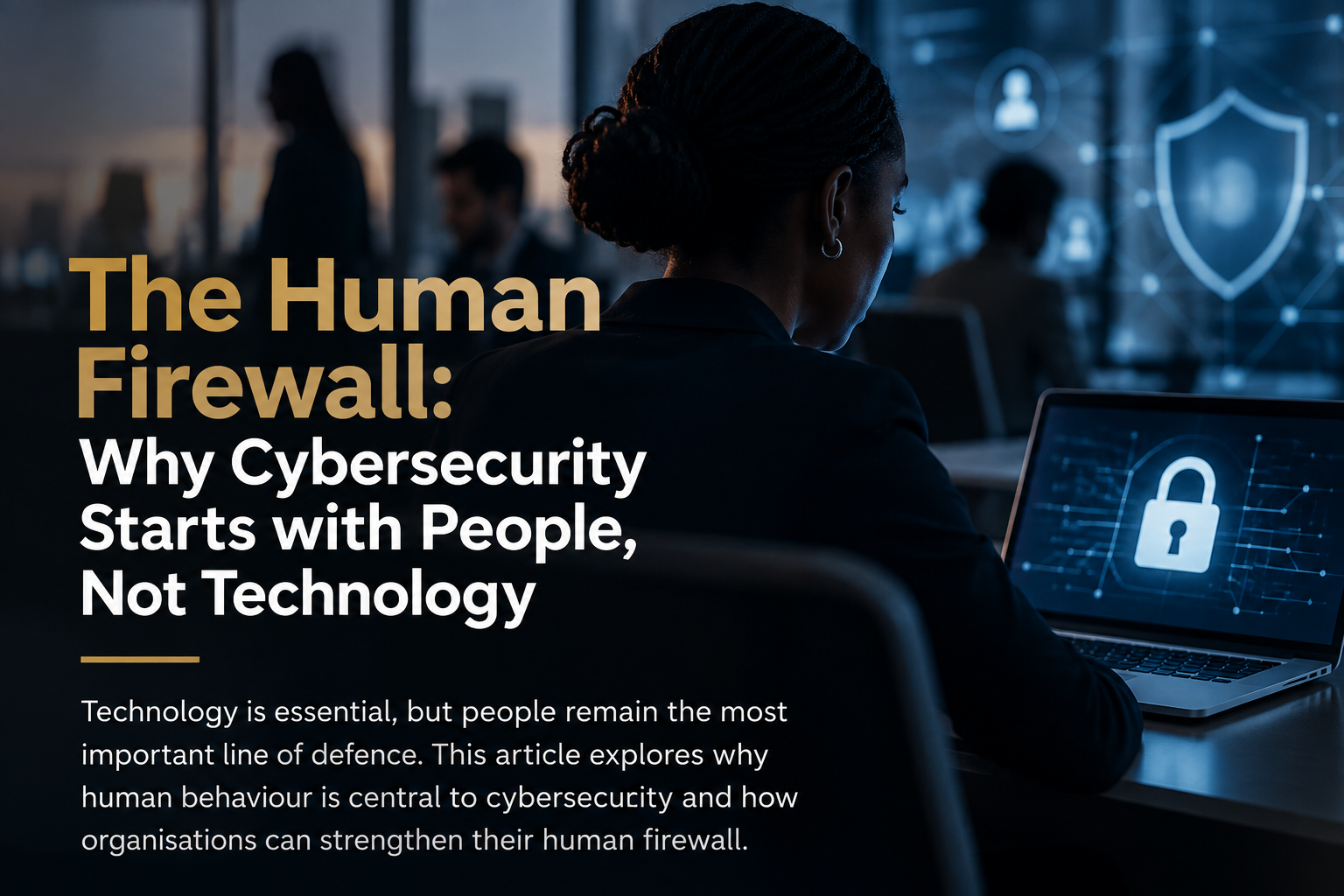
Why Cybersecurity Starts with People,
Not Technology
Organisations
invest heavily in firewalls, encryption, endpoint protection and
increasingly sophisticated security systems, yet many cyberattacks still
begin with something technology cannot completely control: human behaviour.
A convincing
phishing email, a reused password, an unexpected multi-factor authentication request
or a fraudulent message appearing to come from a trusted colleague can be
enough to bypass layers of technical protection. Cybercriminals understand
this. Rather than attacking systems directly, they increasingly target the people
who have legitimate access to them.
This is the
idea behind the human firewall — employees who can recognise suspicious
activity, question unusual requests and respond appropriately before a
potential threat becomes an incident.
Technology
remains essential to cybersecurity, but it is only part of the defence. A
resilient organisation needs people who understand that cybersecurity is not
simply an IT responsibility; it is a shared organisational responsibility.
When Cybercriminals Target People, Not Systems
Cybercriminals have become increasingly effective at
exploiting trust, urgency, curiosity and fear. Social engineering
attacks are designed to make people act before they have time to question what
they are seeing — whether that means clicking a malicious link, opening an
attachment, sharing credentials or approving an unexpected request.
The sophistication of these attacks is also changing.
Phishing messages can closely imitate legitimate organisations, while
compromised email accounts can allow criminals to communicate from addresses
employees already trust. Artificial intelligence can further improve the
quality and personalisation of fraudulent messages, making traditional warning
signs less reliable.
This means cybersecurity awareness cannot simply teach
employees to “spot a suspicious email.” People need to develop the habit of verifying
unusual requests, protecting credentials, questioning unexpected changes and
reporting concerns quickly.
Cybersecurity becomes stronger when secure behaviour
becomes part of everyday decision-making, rather than something employees think
about only during annual training.
The Weakest Link — or the Strongest Defence?
Employees are often described as the weakest link in
cybersecurity, but that view overlooks their potential to become one of an
organisation’s strongest lines of defence. A well-informed employee can
recognise and interrupt an attack before technical controls ever need to
respond.
The difference lies in awareness, behaviour and
organisational culture. Employees need to understand not only what cyber
threats look like, but why certain behaviours matter — from using strong
authentication and protecting sensitive information to verifying payment
instructions and reporting suspicious activity promptly.
Organisations also need to make secure behaviour easy. Clear
reporting channels, practical guidance and regular awareness initiatives help
employees respond confidently when something unusual occurs. Just as
importantly, staff should feel comfortable reporting mistakes quickly rather
than hiding them for fear of blame.
A single employee who questions an unusual request can
prevent a significant incident. Conversely, a workforce that assumes
cybersecurity belongs solely to the IT department can leave even sophisticated
technical defences exposed.
The human firewall becomes effective when employees stop
being passive users of security controls and become active participants in
protecting the organisation.
AI is Changing the Human Threat
Artificial intelligence is making social engineering faster,
more convincing and harder to detect. Cybercriminals can use AI to create
polished phishing emails, imitate writing styles and personalise messages using
information gathered from public sources.
The threat extends beyond email. AI-generated voice and
video impersonation can make fraudulent requests appear to come from
executives, colleagues, clients or suppliers. A familiar voice or convincing
video call can no longer be treated as unquestionable proof of identity.
This changes the way employees need to think about
cybersecurity. Instead of relying solely on visual clues or instinct,
organisations need clear verification procedures for sensitive requests,
particularly those involving payments, credentials, confidential information or
changes to banking details.
In the age of AI, seeing — and even hearing — is no
longer necessarily believing.
Building the Human Firewall
A strong human firewall is not built through one annual
awareness session or a compliance checklist. It is developed through
consistent reinforcement, practical training and clear expectations about how
employees should respond when something appears unusual.
Training should reflect the threats employees actually encounter
phishing, fraudulent payment instructions, credential theft, impersonation
and suspicious requests for information. Regular simulations and real-world
examples can help employees recognise these tactics before they face them in a
genuine attack.
Just as important is what happens when something goes wrong.
Employees need simple reporting channels and confidence to report quickly.
A delayed response can give an attacker valuable time to exploit compromised
credentials, access information or move funds.
The goal is not to eliminate human error. It is to create
an organisation capable of recognising it, reporting it and responding before
it becomes a crisis.
Cybersecurity Is a Culture, Not a Checklist
Technology can strengthen an organisation’s defences, but security
culture determines how people behave when the unexpected happens. Policies
and controls have limited value if employees bypass them, ignore warning signs
or hesitate to report suspicious activity.
A strong cybersecurity culture starts with leadership and
extends across the organisation. Employees should understand that protecting
information, verifying unusual requests and challenging suspicious activity are
part of their everyday responsibilities — not simply the responsibility of
IT.
The strongest organisations do not expect people to be
perfect. They create an environment where employees remain alert, question what
appears unusual and act quickly when something goes wrong.
Cybersecurity does not begin with technology. It begins
with people who understand what they are protecting — and why it matters.
D-finitive Insights
At D-finitive Advisory, we believe effective cybersecurity
requires more than sophisticated technology. It requires an organisation where people
understand risk, recognise warning signs and know when to challenge what
appears unusual.
Many cyber incidents begin with a simple human interaction —
an email opened, a credential shared, a payment approved or a request trusted.
Strengthening the human firewall therefore means building awareness,
accountability and a culture of verification into everyday operations.
Technology can detect threats and strengthen controls, but
people provide something technology cannot replace context, judgement and
the ability to question intent.
For organisations, the aim should not be to remove people
from cybersecurity. It should be to make them an active part of the defence.
Because the strongest firewall may not be the one
protecting the network — it may be the person who stops, questions and verifies
before acting.
Delivering Clarity. Protecting
Integrity. Driving Accountability.