

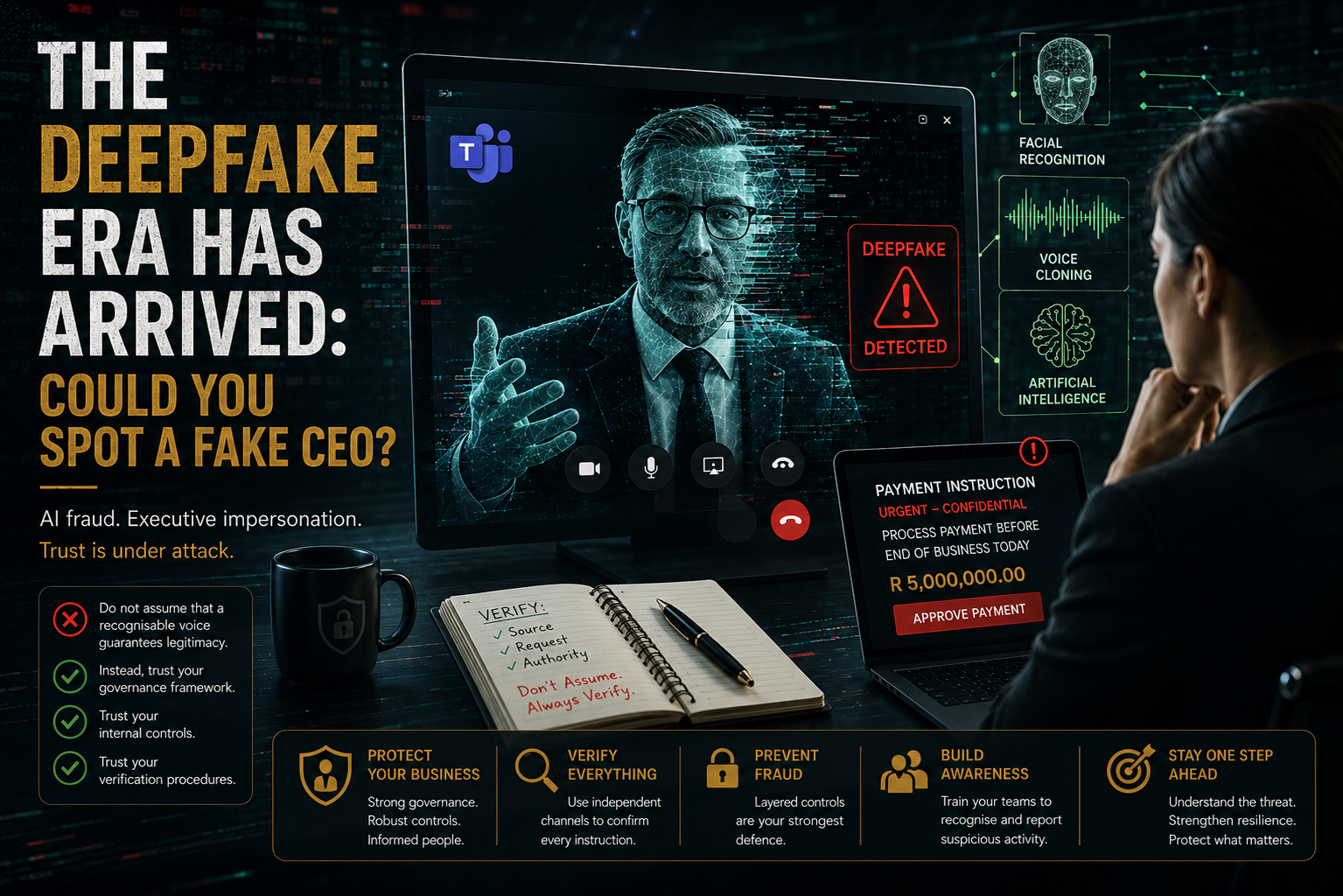
The Deepfake Era Has Arrived: Could You Spot a Fake CEO?
When Seeing Is No Longer Believing
Artificial Intelligence (AI) is transforming the way
organisations operate. From automating repetitive tasks and enhancing customer
service to analysing complex datasets and supporting strategic decision-making,
AI has become an indispensable business tool. Organisations across every
industry are embracing AI to improve efficiency, enhance productivity and
unlock new opportunities for innovation.
Yet, every technological advancement creates new
opportunities—not only for businesses, but also for cybercriminals. As
organisations accelerate their adoption of artificial intelligence, threat
actors are exploiting the same technologies to make fraud, deception and social
engineering attacks increasingly sophisticated, scalable and difficult to
detect.
One of the most concerning developments is the rapid
evolution of deepfake technology—a form of artificial intelligence
capable of producing highly realistic videos, voice recordings and images that
convincingly imitate real people. What was once the subject of science fiction
has become an accessible tool that can be used to impersonate executives,
public figures and trusted individuals with remarkable accuracy.
Unlike traditional cyberattacks that target systems and
software vulnerabilities, deepfake-enabled attacks target something far more
valuable: human trust. Rather than compromising networks, criminals
manipulate people by creating convincing digital impersonations that appear
authentic enough to influence decisions, authorize payments or bypass
established controls.
For decades, organisations have relied on familiar voices,
recognised faces and trusted relationships as indicators of authenticity. A
telephone call from a senior executive, a Microsoft Teams meeting with the
Managing Director or a video message from a colleague would rarely be
questioned. Today, those assumptions can no longer be taken for granted.
Artificial intelligence is fundamentally changing how
organisations must think about trust, identity and verification. In an
environment where seeing and hearing are no longer reliable indicators of
authenticity, strong governance, effective internal controls and independent
verification processes have become essential safeguards against an emerging
generation of fraud.
What Exactly Is a Deepfake?
A deepfake is digitally manipulated content generated using
artificial intelligence that is designed to imitate a real person's appearance,
voice or behaviour.
Unlike traditional photo editing or voice impersonation,
deepfake technology uses machine learning algorithms that analyse existing
videos, audio recordings and photographs to recreate an individual's facial
expressions, speech patterns, tone of voice and mannerisms.
The more publicly available information exists about a
person, the easier it becomes for artificial intelligence to build an
increasingly convincing digital replica.
·
Corporate websites
·
LinkedIn videos
·
Conference presentations
·
Television interviews
·
Podcasts
·
Webinars
·
Social media content
Every interview, webinar, podcast or conference presentation
contributes to an increasingly accurate digital profile that criminals can
exploit to create convincing impersonations.
Why Executives Have Become Prime Targets
Senior executives have become some of the most attractive
targets for cybercriminals. Modern organisations actively encourage executive
visibility to strengthen stakeholder confidence and enhance brand recognition.
CEOs, Managing Directors and senior executives regularly appear in promotional
videos, interviews, webinars and public speaking engagements. Unfortunately,
this visibility also provides criminals with exactly what they need.
Every public appearance helps artificial intelligence learn:
·
Facial movements
·
Speech patterns
·
Voice characteristics
·
Gestures
·
Expressions
·
Body language
The irony is difficult to ignore. The more successful and
visible an executive becomes, the easier it becomes for criminals to
impersonate them.
Executive Impersonation Has Entered a New Era
For years, organisations have been targeted through Business
Email Compromise (BEC), where criminals impersonated executives by sending
convincing emails requesting urgent payments or confidential information. Artificial
intelligence has fundamentally changed this threat.
Today, criminals have demonstrated the ability to exploit
artificial intelligence across multiple communication channels, including:
·
AI-generated Microsoft Teams or other virtual
meetings
·
AI-generated or cloned WhatsApp voice messages
·
Deepfake video messages impersonating executives
·
AI-generated videos falsely depicting trusted
public figures or business leaders endorsing products or investments
Although the
technology has evolved dramatically, the objective has not. Criminals continue
to exploit three fundamental weaknesses:
·
Trust
·
Urgency
·
Human behaviour
Artificial intelligence has simply made the deception more
convincing than ever before.
South Africa Is Not Immune
While highly sophisticated live deepfake video attacks
remain relatively uncommon in South Africa, the technologies that enable them
are already being exploited by cybercriminals. AI-generated investment scams,
cloned voices, fraudulent WhatsApp messages and executive impersonation
attempts are becoming increasingly prevalent, demonstrating that
deepfake-enabled fraud is no longer a theoretical concern
The Financial Sector Conduct Authority (FSCA) has
warned the public about fraudulent investment advertisements that used
AI-generated videos falsely depicting respected financial journalists Maya
Fisher-French and Bruce Whitfield endorsing investment opportunities
they had never supported. These convincing deepfakes were specifically designed
to exploit public trust and persuade victims to invest in fraudulent schemes
Similarly, the South African Banking Risk Information
Centre (SABRIC) has cautioned that criminals are increasingly using
artificial intelligence to create cloned voices, impersonate banking
representatives and produce highly convincing digital communications aimed at
stealing money and sensitive information. Collectively, these incidents
demonstrate that AI-enabled deception has evolved from an emerging cyber threat
into a tangible operational and governance risk that organisations can no
longer afford to ignore
For many South African organisations, the first deepfake
attack is unlikely to involve a sophisticated video conference. It is far more
likely to begin with something familiar—a WhatsApp voice note from the
"Managing Director", an urgent telephone call from a trusted
executive, a convincing email requesting an immediate payment, or a video
message instructing an employee to bypass established approval processes. By
the time the deception is discovered, the financial loss, reputational damage and
erosion of trust may already have occurred.
Case Study: When AI Cost a Company US@25 Million
One of the most widely reported deepfake fraud cases
occurred in Hong Kong during 2024. An employee of the engineering firm Arup
received what appeared to be a legitimate request from the company's Chief
Financial Officer regarding a confidential transaction.
Initially suspicious, the employee joined a video conference
where several familiar colleagues—including the CFO—appeared to participate.
The meeting looked genuine.
The voices sounded authentic.
The faces were familiar.
Believing the request was legitimate, the employee
authorised approximately US$25 million in transfers before discovering that
every participant in the meeting had been an AI-generated impersonation.
The organisation's internal systems had not been hacked.
Its employees had
The incident demonstrated that even vigilant employees can
become victims when familiar faces and trusted authority figures appear to
validate fraudulent instructions.
The Real Threat is Not Technology - It's Trust
Deepfake attacks succeed because they exploit something far
more valuable than software.
They exploit trust.
Employees naturally trust:
·
familiar faces;
·
recognised voices;
·
respected leaders;
·
established relationships;
·
organisational hierarchy.
Artificial intelligence simply weaponises that trust. The
challenge facing organisations today is no longer identifying suspicious emails
filled with spelling mistakes. It is determining whether the person appearing
on the screen is actually who they claim to be.
Warning Signs Every Organisation Should Recognise
Although deepfake technology continues to improve,
organisations should remain alert to unusual behaviour. Potential warning signs
include:
·
Requests to bypass normal approval procedures.
·
Sudden pressure to process urgent payments.
·
Instructions to maintain secrecy.
·
Requests to change supplier banking details.
·
Unexpected WhatsApp voice notes requesting
financial transactions.
·
Executive requests received outside normal
communication channels.
·
Calls encouraging employees to ignore
established controls.
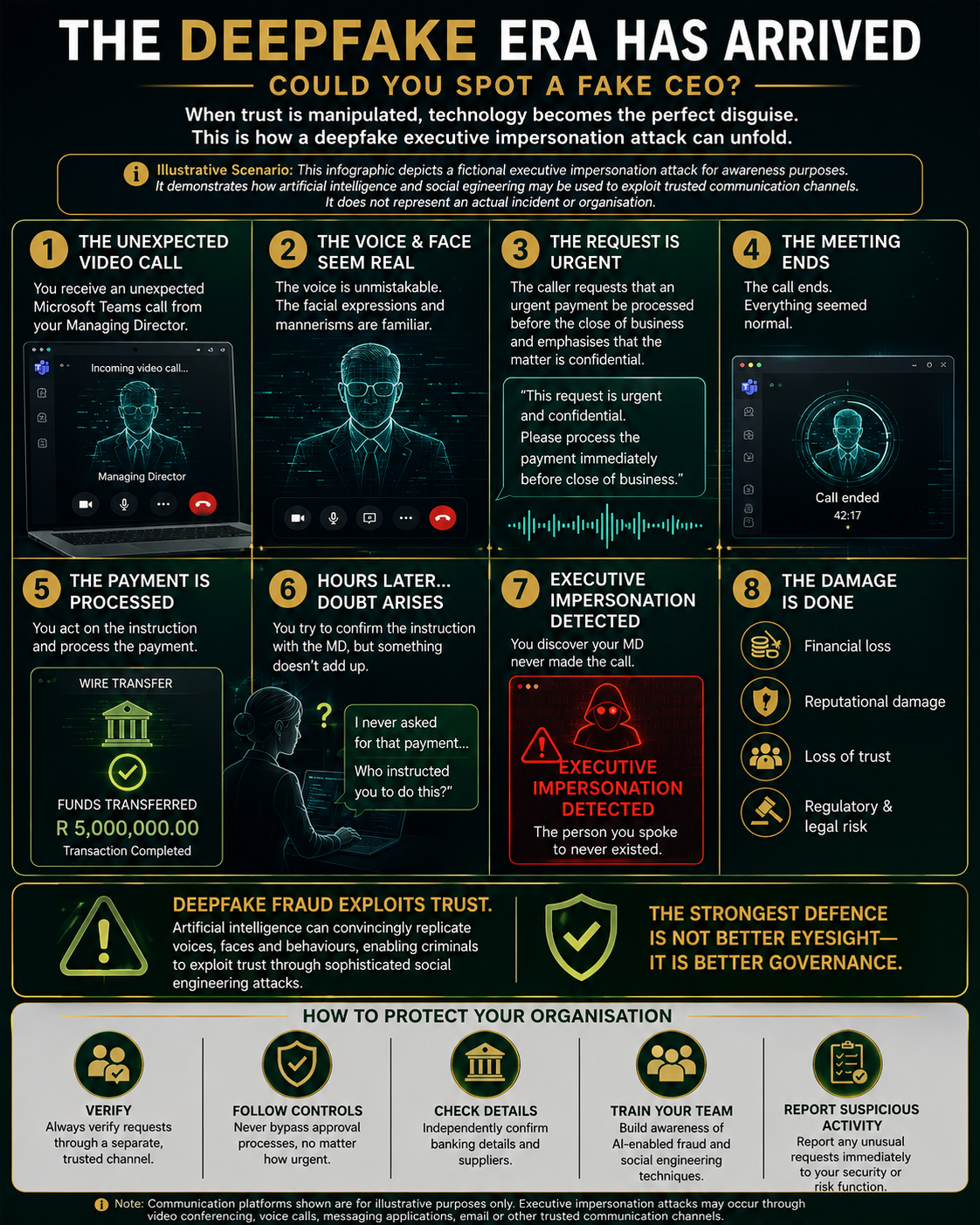
Rather than attempting to detect whether a voice or face is
genuine, organisations should focus on verifying the instruction itself.
Why Internal Controls Matter More Than Ever
Technology alone cannot eliminate deepfake fraud.
Strong governance remains the most effective defence.
Every organisation should implement:
·
Dual approval for high-value payments.
·
Independent verification of banking detail
changes.
·
Call-back verification using trusted contact
information.
·
Segregation of duties.
·
Employee awareness training.
·
Executive fraud awareness programmes.
·
Incident response procedures for AI-enabled
fraud.
Employees should never feel pressured to bypass internal
controls simply because the request appears to come from a senior executive. A
robust control environment protects both the organisation and its leadership.
The Boardroom Must Treat AI as a Governance Risk
Artificial intelligence is no longer simply an IT issue. It
is a governance issue. Boards should ensure that AI-enabled fraud is
incorporated into:
·
Enterprise Risk Management frameworks.
·
Fraud Risk Assessments.
·
Cybersecurity Strategies.
·
Business Continuity Plans.
·
Internal Audit programmes.
·
Executive awareness initiatives.
The organisations that adapt first will be far better
positioned to manage this emerging threat.
Final Thoughts
For generations, people have relied on one simple
assumption. Seeing is believing. Artificial intelligence has
fundamentally changed that assumption.
Deepfake-enabled fraud is not simply a cybersecurity issue.
It is a governance, fraud risk and internal control challenge that requires
collaboration between Boards, executive management, risk functions, internal
audit, compliance and information security. Organisations that respond through
technology alone are likely to overlook the broader governance failures that
allow these attacks to succeed.
For South African organisations, the message is clear.
❌ Do not assume
that a familiar face guarantees authenticity.
❌ Do not assume
that a recognisable voice guarantees legitimacy.
✅ Trust your governance framework.
✅
Trust your internal controls.
✅
Trust your verification procedures.
In the age of artificial intelligence, the strongest defense
against deception is not better eyesight—it is better governance.
D-finitive Insight
Artificial
intelligence is reshaping both business and cybercrime. As criminals adopt
increasingly sophisticated methods to exploit trust, organisations must evolve
just as quickly. Effective governance, strong internal controls, cyber
resilience and informed employees are no longer optional—they are essential
safeguards against emerging threats.
Through
governance, risk management, digital forensics, forensic investigations and
financial crime advisory services, D-finitive Advisory helps
organisations identify emerging threats, strengthen governance frameworks,
enhance fraud resilience and protect what matters most.
Delivering Clarity. Protecting
Integrity. Driving Accountability.